
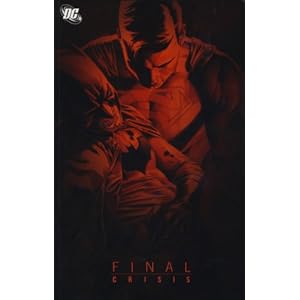
I find Grant Morrison's writing to be something of a mixed bag. There's obviously elements of brilliance in his work but it sometimes seems camoflaged by minimist storytelling ability and weird dialogue peppered with pseudoscientific twaddle. Some of the stuff he's done - Earth 2, We3 and in fact most of the stuff he's done with Frank Quitely - is very good but then other work - such as some of the JLA stuff he did - left me cold and wondering what the heck it was all about. Unfortunately, Final Crisis falls more in the latter camp.
Not that it's terrible - I've read much worse in my 30+ years of comic reading. It's pretty entertaining, especially the middle part once you get into it. However, I think it might have helped if I've read some of the other DC comics before Final Crisis - things like Seven Soldiers or Countdown - and knew more about the preceding fate of the New Gods and about characters like the Super Young Team and others. Morrison doesn't seem to be a fan of exposition and explaining what's gone before nor even what's going on in the book itself. I think he leaves it to the artist to tell the story, which can work with someone like Quitely but not here.
This lack of explanation means that sometimes you'll read a page or two and wonder what the heck actually happened. Questions like 'Who did what to who?' and 'Who's that and why are they there?' occur at times making this not an easy read. Some have said it's complex but it's more the case that Morrison doesn't make it easy to read. Books can be both complex and easy to read, you know, but this book isn't one of those.
Couple this with Morrison's strange dialogue, which sometimes seems to come out of order. Sometimes it felt like the word balloons should be read in reverse - which would be quite fitting given that the story contains a bullet that is fired backwards in time. Seriously - I actually read some of the pages in reverse and it made just as much sense as reading them the normal way.
Talking of the time-defying bullet - why? How does a bullet, even one that's fired backwards in time, kill Orion (a New god)? And why was Orion shot in some back alley on Earth? Why a bullet and not Darkseid's Omega Beams?
I can only think that Morrison wanted to start this series with a New God found dead in some alley somewhere (vague similarities to Watchman come to mind here) and thought a time-travelling bullet would be 'fun'. Morrison just makes it more complicated than it really needs to be.
Then there's the final issue and the final showdown. This, quite frankly, I found to be a mess. By this point, Batman has already suddenly popped up for about two pages (after being missing for much of the book) shoots Darkseid and promptly dies. Don't worry, we soon find out he's only been sent back in time. The shot doesn't kill Darkseid so Superman confronts him. But also seems to go off and build a Miracle Machine that does, erm, nothing over than provide a "happy ending". He also sings the frequencies to cancel out Darkseid - or maybe the Multiverse. And it seems that Woman Woman binds Darkseid with her lasso for some reason. Plus a bunch of other stuff. Not that the artist shows any of this because it is all just told to us using captions.
It's like Morrison ran out of room, had a bunch of great ideas and threw them all in, one page after another with no narrative to explain it. Instead he relied on the old favourite of having the (vague) tale told after the fact to some gathered people, a bit like the "Previously on..." bit at the beginning of some TV shows. This works at the beginning but not at the end of a story! So, yeah, the finale was a little disappointing.
Anyway, enough bashing of Morrison's strange storytelling and onto the art.
J. G. Jones starts the book and is a pretty good artist. His lines are clean, hinting at a realistic approach whilst still being comic-booky. He's sort of a cross between Bryan Hitch and Alan Davis, which isn't a bad cross to be - even if he isn't quite as good as either of those two. Here, his work is similar to that on Wanted, but actually better in my opinion. Unfortunately, very occasionally his art looks rushed in this book. And indeed, it seems, he couldn't keep up with the schedule and Carlos Pacheco, and later Doug Mahnke, had to be brought in to help out.
Now, usually Pacheco is a very good artist. I loved his stuff on Avengers Forever and JLA/JSA Virtue and Vice. But here it looks like he wasn't given much time and so his usual quality slipped. It suffers when compared to Jones' panels. And, I'm sorry to say, I'm not much of a fan of Mahnke grimacing, weirdly-proportioned artwork. His art put me off JLA some years ago (though it didn't help that Judd Winick was the writer at the time either) and here, although it is better, for me it still doesn't compare to the art that precedes it.
So, overall, a mixed bag. The book seems difficult to get into and suffers from the old crossover problem where not all the story is represented in the mini-series itself. However, the middle third picks up considerably but then it is hampered by the changing art and that messy ending. For me, of the three Crises up to now, this one is the least satisfying. Entertaining but not excellent. Perhaps more for fans of Morrison's other DC work?
Grade: Good.

 (this shunkkch-ing panel is taken from Infinite Crisis #6 written by the current master of mainstream bloodsplatter Geoff Johns, pencils by Phil Jiminez and inks by Andy Lanning)