It was also a better epsiode this week in Smallville as things start to kick off. You can tell it's getting close to the end of the season as storylines begin to get resolved and the action starts to ramp up ready for the season final.
This week started with the Watchtower going into lockdown when Checkmate starts to hack its computer systems. Can someone tell me why? It's being hacked from outside (using a device in Tess' body) so what good will sealing the place do? Other than nearly killing Chloe and Tess, that is?
Actually, Tess does die. Chloe kills her in order to shut down the router device inside Tess. Later, Chloe is able to bring Tess back to life because, of course, she's a skilled medical professional and is able to get those defribrillator shock paddles to work through Tess' top. And, miraculously, Tess gets up immediately with no brain damage due to being dead for an hour (or however long it was).
Meanwhile, Green Arrow fights Zod. Luckily GA has a handy kryptonite arrow in his arsenal (handy that) but ultimately it does no good. At first, I thought Zod (and Smallville's writers) had killed Oliver and burnt his face off, but that was just some other guy. Instead, it seems GA is going to have to change his codename to Zenith or something - what with that big Z burnt into his chest!
Slight aside but I'm not thrilled by Smallville's Zod. Callum Blue doesn't seem to have the right presence for one of Superman's main enemies. And his accent just sticks out like a sore thumb.
Anyway, elsewhere Checkmate kidnaps the Kandorians but then Clark rescues them. In retaliation Zod attacks Checkmate's base causing mucho destructiono. In the end, Zod and all of the Kandorians gather at the Fortress of non-Solitude - well, all except the pregnant Faora (or whatever her name is) who Zod had strangled earlier, hence the title of this episode I guess. We then find out that Zod has very quickly given the rest of the Kandorians a blood transfusion because they then all flew off.
Which again highlights a problem with Smallville - how come Clark hasn't learnt to fly yet? Kara (Supergirl) could. Zod can. The poor Kandorians, who have been sat around doing nothing for weeks, pick it up in no time at all. Heck, even evil Clark could fly. But not bland Clark. SFX-wise, you could just say that when Clark runs away at superspeed he's actually flying away at superspeed, so it can't be that. It just seems like a silly restriction (there are lots of those in Smallville).
Only two more episodes to go...

Saturday, October 09, 2010

Friday, October 08, 2010
Merlin: Gwaine
Well, this week's episode was a step up from last week but still didn't achieve the excitement of the first two epsiodes of Season 3. It was suitably dramatic with a couple of nice fight scenes - the beginning bar-room brawl and the armoured sword fight at the end - but still felt somewhat average. However, I did thoroughly enjoy the character of Gwaine (I always thought it was spelt Gawain - or is that another knight?) and thought Eoin Macken played him in a wonderfully rough but charming manner.
The story seemed somewhat familiar though - a sort of conglomoration of the attempted assasination at a tournament (like season 1's "Valiant" or season's 2's "The Once and Future Queen") with the introduction of one of the knights of the Round Table (like "Lancelot", again from season 1). The bad guys must've had one heck of a grudge against Arthur because they went to a lot of trouble to kill him. Why not just pretend to be a knight and live the high life at Camelot or elsewhere? Also, it was kinda handy for the tournament that they got hold of some magical 'blunt' swords.
In a way, although this week was better, part of me enjoyed last week's episode more for some reason. That earlier episode was lighter, I guess. Still, "Gwaine" was enjoyable just nothing to get excited about. And, again, it did nothing to further any ongoing storyline as at the end we saw Gwaine being sent away from Camelot probably never to be seen again. Pity.
Saturday, October 02, 2010
Final Crisis
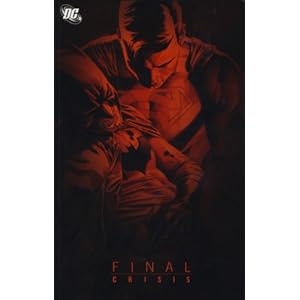
I find Grant Morrison's writing to be something of a mixed bag. There's obviously elements of brilliance in his work but it sometimes seems camoflaged by minimist storytelling ability and weird dialogue peppered with pseudoscientific twaddle. Some of the stuff he's done - Earth 2, We3 and in fact most of the stuff he's done with Frank Quitely - is very good but then other work - such as some of the JLA stuff he did - left me cold and wondering what the heck it was all about. Unfortunately, Final Crisis falls more in the latter camp.
Not that it's terrible - I've read much worse in my 30+ years of comic reading. It's pretty entertaining, especially the middle part once you get into it. However, I think it might have helped if I've read some of the other DC comics before Final Crisis - things like Seven Soldiers or Countdown - and knew more about the preceding fate of the New Gods and about characters like the Super Young Team and others. Morrison doesn't seem to be a fan of exposition and explaining what's gone before nor even what's going on in the book itself. I think he leaves it to the artist to tell the story, which can work with someone like Quitely but not here.
This lack of explanation means that sometimes you'll read a page or two and wonder what the heck actually happened. Questions like 'Who did what to who?' and 'Who's that and why are they there?' occur at times making this not an easy read. Some have said it's complex but it's more the case that Morrison doesn't make it easy to read. Books can be both complex and easy to read, you know, but this book isn't one of those.
Couple this with Morrison's strange dialogue, which sometimes seems to come out of order. Sometimes it felt like the word balloons should be read in reverse - which would be quite fitting given that the story contains a bullet that is fired backwards in time. Seriously - I actually read some of the pages in reverse and it made just as much sense as reading them the normal way.
Talking of the time-defying bullet - why? How does a bullet, even one that's fired backwards in time, kill Orion (a New god)? And why was Orion shot in some back alley on Earth? Why a bullet and not Darkseid's Omega Beams?
I can only think that Morrison wanted to start this series with a New God found dead in some alley somewhere (vague similarities to Watchman come to mind here) and thought a time-travelling bullet would be 'fun'. Morrison just makes it more complicated than it really needs to be.
Then there's the final issue and the final showdown. This, quite frankly, I found to be a mess. By this point, Batman has already suddenly popped up for about two pages (after being missing for much of the book) shoots Darkseid and promptly dies. Don't worry, we soon find out he's only been sent back in time. The shot doesn't kill Darkseid so Superman confronts him. But also seems to go off and build a Miracle Machine that does, erm, nothing over than provide a "happy ending". He also sings the frequencies to cancel out Darkseid - or maybe the Multiverse. And it seems that Woman Woman binds Darkseid with her lasso for some reason. Plus a bunch of other stuff. Not that the artist shows any of this because it is all just told to us using captions.
It's like Morrison ran out of room, had a bunch of great ideas and threw them all in, one page after another with no narrative to explain it. Instead he relied on the old favourite of having the (vague) tale told after the fact to some gathered people, a bit like the "Previously on..." bit at the beginning of some TV shows. This works at the beginning but not at the end of a story! So, yeah, the finale was a little disappointing.
Anyway, enough bashing of Morrison's strange storytelling and onto the art.
J. G. Jones starts the book and is a pretty good artist. His lines are clean, hinting at a realistic approach whilst still being comic-booky. He's sort of a cross between Bryan Hitch and Alan Davis, which isn't a bad cross to be - even if he isn't quite as good as either of those two. Here, his work is similar to that on Wanted, but actually better in my opinion. Unfortunately, very occasionally his art looks rushed in this book. And indeed, it seems, he couldn't keep up with the schedule and Carlos Pacheco, and later Doug Mahnke, had to be brought in to help out.
Now, usually Pacheco is a very good artist. I loved his stuff on Avengers Forever and JLA/JSA Virtue and Vice. But here it looks like he wasn't given much time and so his usual quality slipped. It suffers when compared to Jones' panels. And, I'm sorry to say, I'm not much of a fan of Mahnke grimacing, weirdly-proportioned artwork. His art put me off JLA some years ago (though it didn't help that Judd Winick was the writer at the time either) and here, although it is better, for me it still doesn't compare to the art that precedes it.
So, overall, a mixed bag. The book seems difficult to get into and suffers from the old crossover problem where not all the story is represented in the mini-series itself. However, the middle third picks up considerably but then it is hampered by the changing art and that messy ending. For me, of the three Crises up to now, this one is the least satisfying. Entertaining but not excellent. Perhaps more for fans of Morrison's other DC work?
Grade: Good.
Thursday, September 30, 2010
Smallville: Charade (s9 ep18)
The UK's Smallville is a little behind the US - who are now getting the first episodes of a Darkseid-infested tenth season - but only by about half a season. Over this side of the pond, this week's episode comes about two thirds of the way through Season 9 and again promotes the Checkmate storyline that has been running alongside the Zod & the Kandorians story this season. And, to be honest, it was pretty forgettable.
Now, Smallville is a guilty pleasure of mine. I like it and feel that these later seasons are probably the most comicbooky of all live action TV shows in the last few years. But this episode just seemed to be... "meh".
In it, it had something about Lois and Clark investigating why the conviction of an ex-DA had been overturned. Apparently, this DA had thrown Lois off a building at some point previously - can't say I remembered that so thankfully the pre-credits "Previously" bit reminded me. They find out only the governor could have released him and one of the governor's biggest backers is one Maxwell Lord. Aha! Another well-known DC character crawls out of the woodwork. I knew I had seen the guy who played Maxwell Lord before but it took me some time to realise he played Billy in Ally McBeal. To be honest, he's not who I would have considered for the part but he does the job, I suppose.
Not that this Maxwell Lord is the same as the comic book version, of course. This is Smallville after all, and here he seems to have the power of telepathy and making his hand glow blue. He's captured a number of people that the Blur (Clark) had encountered - including Lois - in order to extract the Blur's identity from the glimpses within their minds.
All very well and good, but this slight storyline was padded out with gooey emoting about the Lois/Clark/Blur triangle. I know the teenage relationship stuff is a big part of Smallville (even though the characters are surely now well into their 20s and Tom Welling might almost be as old as me - though somewhat more handsome) but I just thought it was a little too much this week. Perhaps it might have been better if the Checkmate/Lord storyline had been better?
Still, we were left wondering who the Red Queen was that Max encountered (it's sort of made to look like it could be Tess - although I know who it actually is). And it was good to see a Maxwell Lord, I suppose. The bit of action when Clark jumped into the slowly-resolving, holographic Blur identity thingy looked quite impressive too.
Let's hope things pick up in the last 3 (is it 3?) episodes and something actually happens with the whole Kandorian arc (because they just seem to have been kinda hanging around for half the season, poor chaps).
Wednesday, September 29, 2010
Merlin: Goblin's Gold
Ah, back to the old burp and fart humour.
The first two-part story of season 3 of Merlin ("Tears of Uther Pendragon")
was a cracker. Generally dark, dramatic, entertaining, engaging and action
packed. The ending was perhaps wrapped up a bit too neatly - by which I mean
they pretty much hit the reset button - but otherwise enjoyable.
But this weeks episode took me back to season 1.
It was humorous and amusing in parts - like when Arthur (or should that be
Eeyore?) became a half-donkey - and it was good to see a little more of
Gaius (played by the lovely Richard "I don't believe it!" Wilson). The
goblin was reasonably well-animated - although they didn't quite manage to
pull off the integration of the CGI into the real world. And at least they
didn't overuse the crude humour.
Still, in the end, it felt like a filler episode and one that had no impact
in the overall story - if there actually is one in Merlin. This episode
could've taken place in any of the previous seasons and the only thing that
would have had to be changed was Gaius-Goblin's mention of Morgana's
darkness. Although even that could've been some handy foreshadowing.
So, although not bad, it wasn't great either. The preview of next week's
episode looks better, although the whole
"Arthur-targeted-at-tournament-but-is-saved-by-knight-of-round-table" seems
somewhat familiar. We'll see.
Saturday, September 25, 2010
Testing...
Thought I'd try a test post from my iPod Touch to see how easy it is. And whether it actually works! This is all in preparation for a forthcoming trip to Florida and the Land of the Mouse-ears (ie. Walt Disney World) where I might post something. If i have a wireless connection, that is.
Anyway that's it for now. Heck I might even do some other posts about Merlin or Smallville or something. :)
Anyway that's it for now. Heck I might even do some other posts about Merlin or Smallville or something. :)
Thursday, May 06, 2010
Iron Man 2
It makes a change for the UK to get a film like this before the Americans do. It means this review is actually slightly early rather than being weeks out of date! Anyway, onwards...
I've seen a number of reviews of this movie saying that it's not as good as the first film. Which is kind of true but also misleading. Because I suspect people see the words "not" and "good" and think that it's going to be, well, a bit rubbish. But that's far from the case. It's a fantastically enjoyable film - just not quite as break-out wonderful as the first one.
Number two sequels tend to do quite well in this genre. Superman 2, Spiderman 2, X-Men 2, Dark Knight were all better than the originals. So I'm guessing people had high hopes for Iron Man 2 and, perhaps, were a little disappointed. Which is a shame. There are some high octane action scenes in the middle and end of Iron Man 2 which, in a way, blow away the action in the first film. The suitcase suit - which also doubles as the red-and-silver version of the Iron Man suit - is brilliantly used in a fight against Whiplash (I would've preferred a version of either Blacklash or Crismon Dynamo from the comic books but Mickey Rourke does play a great Russian supervillain). And there's a rocket-fuelled fight against multiple Hammer-drones and War Machine at the end. The end resolution against Crimson "Whiplash" Dynamo was a bit weak though - he was too easily defeated and an extra couple of minutes of effects here would've helped. Watch out for the "Ex Wife". ;-)
Some have also said that this plays like a 2 hour preview of the upcoming Avengers movie. Which, for me, is a good thing. Hell, it's a fabulous thing! One of the most exciting things about Marvel's recent films is the way that they're taking part in the same shared universe and that Marvel have plans to unite these characters into one big, blockbuster movie. I seriously cannot wait for the Avengers movie and if it's as good as the hints we got here, then it'll be awesome.
Samuel L Jackson is just wonderful as Nick Fury. His interactions with Downey's Tony Stark are priceless. Scarlett Johansson is good as the Black Widow and her fight scene near the end of the film is one of the highlights - she can't half move! What with Fury and the Black Widow, plenty of mentions of S.H.I.E.L.D, an amusing use of Captain America's shield and a post-credit appearance of a certain thundergod's weapon of choice, it shows what an Avengers movie might be like.
So, other than the fact that the story line was perhaps a little weak (a slight case of 'style over substance'), the main bad guy was easily dispatched and that, yet again, Iron Man goes up against interchangeable powered-armoured opponents it was an enjoyable romp. Recommended.
And I just love Gwyneth Paltrow as Pepper Potts. Best character of the lot and gorgeous with it.
Tuesday, January 05, 2010
Doctor Who: The End Of Time
"Your song is ending, sir. It is returning, it is returning through the dark. And then... he will knock four times."
So went the prophecy first stated in Planet of the Dead all those months ago and here, in the latest Doctor Who special - The End of Time - it was Gallifrey that returned, albeit briefly, from the dark in a wonderful, dramatic, emotional (though slightly flawed) story.
The return of the Time Lords - from their dark, shadowy chambers locked within the Time War - was also short-lived. But then we knew it would be because they were fated to die by the Doctor's hand. But during their brief appearance they showed up here on Earth surrounded by bright light (a lovely bit of juxtaposition there) full of pomp and ceremony, with Timothy Dalton playing a spittingly marvellous Rassilon.
All that was after the Master had returned.
And, of course, is wasn't "he" that knocked four times. No, his constant drumbeat - echoing the theme tune and the heartbeat of the Time Lords - was too obvious. Instead, a glass-tapping Wilf in Part Two was a lovely little goose-bump-raising, and somewhat sad, twist towards the end of this final story for the Tenth Doctor.
"I don't want to go"
That's not to say that everything was perfect. Far from it. Part One of the End of Time, shown here in the UK on Christmas Day, was a bit messy. It's like Russell Davies couldn't decide what plot to follow and who was the ultimate enemy. We had the Master returning, then supposedly dying, then some guy called Naismith turning up with an Immortality Gate, then those green, spiky Vinvocci aliens, the Master reappearing and turning the whole Earth into copies of himself and finally the prophesised return of the Time Lords. All in Part One. Whew.
There was a lot going on, a lot of plot holes and unexplained threads, and the pacing was a bit choppy what with the running from one derelict site to another. I enjoyed Part One immensely (and it was nowhere near as bad as some on the internet have made out - it was far from the Worse Episode Ever that some are screaming) but I could see that it had numerous faults and seemed to be a little bit of a letdown considering all the hype.
But I needn't have worried - Part Two was better. Much better.
"Worst... Rescue... Ever!"
Again, it wasn't perfect. But I thought it was a fantastic, thrilling rollercoaster ride to the end. I love stories that circle back around to hint at the beginning and/or reflect earlier plots. At the start of New Who, the Ninth Doctor had just escaped the Time War, obviously devastated by the loss of his race and his actions to prevent their madness from spilling over into Real Time. And here, we have the Time Lords trying to escape the Time War and the Tenth Doctor agonising over whether he should send them back into the Time Lock and to their deaths.
Rassilon's use of the Visionary, a prophecy-spewing madwoman, echoed Davros and mad Dalek Caan from the Stolen Earth special over a year ago. Dalek Caan managed to break into the Time Lock and get Davros out of the Time War, so of course here we have a story where the Time Lords, the arch-enemies of the Daleks, break out of the Time War using a maddened Master. And, in both of those stories, planets appear in the sky above Earth.
Then there was the whole going back to the beginning of 2005 to visit a younger Rose Tyler before she met the Doctor. And it was snowing on the estate, just like it was in the Tenth's first story. Thus the end returns to the beginning.
Some have complained about the Doctor's "reward" at the end, stating that it went on too long or that it felt more like RTD's self-indulgent reward than the Doctor's, but I loved seeing the Doctor visit all his past companions one last time. (And, anyway, the Fifth Doctor took nearly a whole story to "die" and then regenerate from spectrox poisoning in what is considered one of the best Who stories of all time. What's a few hours suffering from radiation poisoning compared to that?). Visions of past companions seem to be a recurring theme with the Doctor's regenerations.
There have been other complaints but, overall, I thought this was wonderful telly! And a great end to David Tennant's, and Russell Davies', tenure on Doctor Who.
"This song is ending, but the story never ends"
It been a great four years with New Who. Who'd have thought this little ol' sci-fi show would be one of the most viewed on British telly before 2005? And now, other than the last 30 seconds of this story, Matt Smith's and Steven Moffat's time on the show starts in Spring. I can't wait!
Subscribe to:
Posts (Atom)